
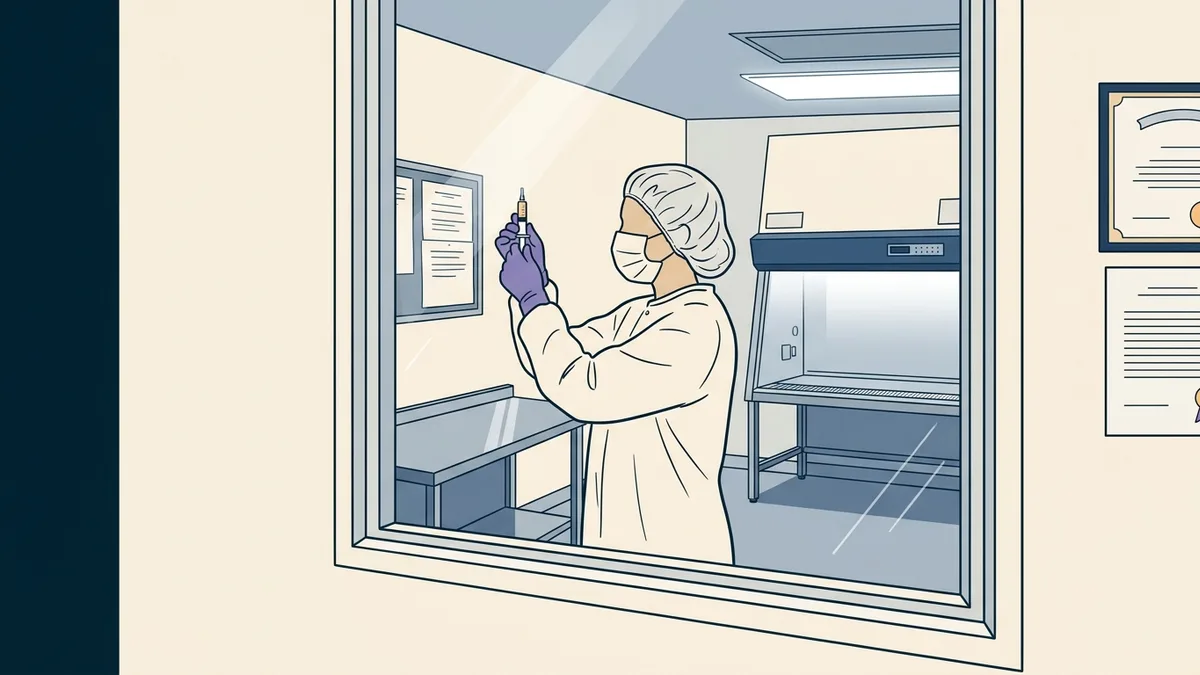
A specialty pharmacy needs a nonresident license in each state it ships to, and sterile compounding often adds a second permit: Florida, Massachusetts and California license it separately, and Texas requires Class E-S. Compounders also face fresher inspection limits, such as Maryland's 90 days for sterile work, and Washington accepts many state inspections only from non-compounders.
Specialty pharmacies usually serve patients across a wide area from one or two locations. That makes them nonresident pharmacies in most of the states they serve, with the same baseline needs as any shipping pharmacy: a home-state license, a recent inspection report, a toll-free pharmacist line and, in a growing group of states, a PIC licensed in that state. What sets specialty work apart is what tends to come with it. Sterile compounding, temperature-sensitive products and complex patient support all bring extra state requirements, and they change which inspection reports a state will accept.
Which states license sterile compounding separately?
If your pharmacy compounds sterile preparations and ships them, plan on more than one credential in several states:
- Florida requires a nonresident sterile compounding permit before shipping "a compounded sterile product into this state." The application includes a written attestation by an owner or officer and by the prescription department manager or PIC, sterile compounding policies that comply with USP chapter 797, and an inspection report no more than six months old for an initial permit or one year old at renewal (Fla. Stat. § 465.0158(1) and (3)).
- Massachusetts requires a non-resident Drug Store Pharmacy license and a non-resident sterile compounding pharmacy license to ship any sterile compounded preparation into the state (247 CMR 6.02(5)).
- California asks every nonresident applicant whether it will compound sterile drug products for shipment into California. If yes, the Nonresident Sterile Compounding Pharmacy License Application goes in with the pharmacy application. If no, a duly authorized officer signs a statement certifying that it will not (Board form 17A-58 instructions, item 10).
- Texas issues a Class E-S license, and Class E personnel "shall not compound sterile preparations" without it (22 Tex. Admin. Code § 291.104(a)(14)). If a Class E-S pharmacy moves, it reverts to Class E until the Board or its designee inspects the new site (§ 291.3(a)(4)).
- Virginia charges a $200 sterile compounding fee on top of the nonresident registration fee for applicants that intend to compound sterile preparations (18VAC110-20-20).
A state-by-state comparison is in nonresident sterile compounding permits by state, with deeper looks at Florida and California.
Why do compounders need fresher inspection reports?
States that accept a two- or three-year-old inspection for a retail pharmacy often want something more recent, and more specific, from a compounder:
- Maryland: a nonresident pharmacy dispensing compounded sterile preparations needs an inspection showing USP 797 compliance, conducted within 90 days before the application by a Board designee or approved entity (Md. Code, Health Occ. § 12-403(f)(1)(v)).
- New Mexico: the most recent compounded sterile preparation inspection, within the 12 months before the Board receives the application (16.19.6.24(C)(1)(d) NMAC).
- Tennessee: an out-of-state pharmacy engaged in compounding must provide an inspection performed within the previous 12 months (Tenn. Comp. R. & Regs. 1140-01-.08(3)(a)4(i)).
- Vermont: compounding and home infusion pharmacies need an inspection assessing USP compliance within two years, against three years for retail pharmacies, and must register with the compounding or home infusion specialty "regardless of products shipped to Vermont" (Vermont instructions, February 2026).
- Virginia: the inspection must show compliance with USP-NF standards for pharmacies performing sterile and non-sterile compounding (Va. Code § 54.1-3434.1(A)(3)).
- North Carolina: if the pharmacy compounds, the inspection submitted with the permit application "must demonstrate compliance with USP chapter standards governing compounding."
How does Washington treat compounding pharmacies?
Washington accepts only inspections from programs its Pharmacy Quality Assurance Commission has approved (RCW 18.64.360(1)(b)). Its Directive D001, effective February 5, 2026, approves the inspection programs of 25 states, including Arizona, Florida, Illinois, Texas and Tennessee, only for nonresident pharmacies "attesting that they do not engage in compounding." A compounding pharmacy based in one of those states needs an inspection from a program on the fully approved list, such as ACHC, NABP's Verified Pharmacy Program or Gates Healthcare Associates. See Washington's approved inspection programs.
Does a specialty pharmacy need in-state pharmacists?
In some states, yes, and it is the longest item on most specialty pharmacies' plans. California's rule became operative July 1, 2026, requiring a California-licensed PIC "employed and working at the nonresident pharmacy" (Bus. & Prof. Code § 4112(d)). Illinois has required an Illinois-licensed PIC since January 1, 2026 (68 Ill. Adm. Code 1330.550(a)). Texas, Virginia, Oklahoma, Oregon, Kentucky, Tennessee, Alabama, Arkansas and Michigan have their own rules, and Oklahoma and Oregon require the PIC to be present at least 20 hours a week. The PIC must be your own pharmacist, working at your pharmacy; nobody outside it can fill the role. See the states that require an in-state licensed PIC.
What should a specialty pharmacy do first?
- Inventory what you ship into each state: sterile preparations, non-sterile compounds, controlled substances and commercial products. The answers decide which permits each state requires.
- Schedule the compounding inspection so its date satisfies the strictest state you plan to file in, then file the states with the shortest windows first.
- Start PIC licensing in parallel. Your pharmacists file their own license transfer through NABP and take each state's law exam; we plan the order and track each state to license.
- Prepare one document set (policies, USP compliance evidence, label sample, ownership chart) and adapt it per state.
What does White Glove Pharmacy Licensing charge for this?
Nonresident applications are $599 per standard state and $899 per complex state with an in-state PIC rule. The Sterile Compounding Add-On is $499 per state and covers the separate sterile permit or the extra compounding documentation. PIC Licensing Coordination is $399 per state per pharmacist. A 10-state package is $4,995 and a 25-state package $10,995; add-ons are priced separately. Owners, officers and PICs sign every attestation, and the pharmacy pays board, inspection and fingerprint fees directly. See pricing and the state requirements table.
Common questions
- Does a specialty pharmacy need a separate sterile compounding permit in each state?
- Not in every state, but in several. Florida requires a nonresident sterile compounding permit, Massachusetts a non-resident sterile compounding license, Texas a Class E-S license, and California a separate sterile compounding license application.
- How recent must a compounding pharmacy's inspection be?
- Shorter than for retail work in many states: within 90 days for sterile work in Maryland, 12 months in New Mexico and Tennessee, six months for Florida's initial sterile permit, and two years in Vermont.
- Why might Washington reject my home-state inspection?
- Washington's Directive D001 accepts inspections from many states only for pharmacies that attest they do not compound. A compounder in one of those states needs an inspection from a fully approved program, such as ACHC, NABP's VPP or Gates Healthcare Associates.
Need Help with Pharmacy Licensing?
We prepare every state's nonresident application for your officers and PIC to sign, coordinate your pharmacists' licenses, and track every one to a decision.