
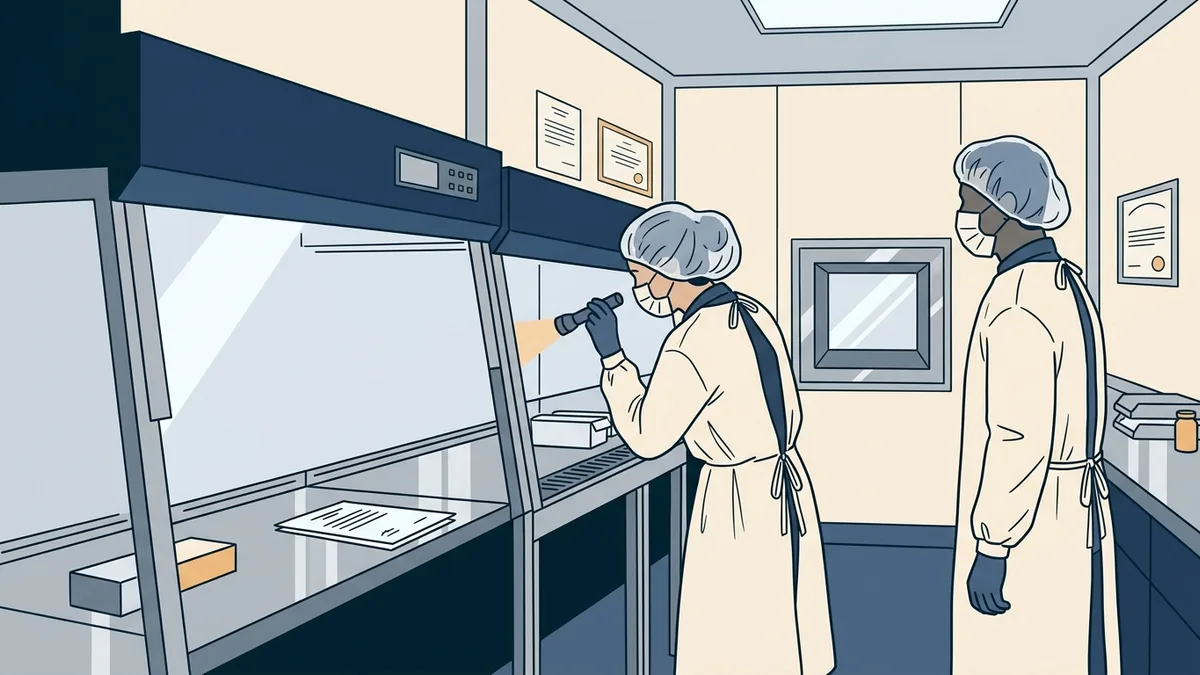
Washington accepts a nonresident pharmacy's inspection only from a program its Pharmacy Quality Assurance Commission approved and issued within two years. Directive D001, effective February 5, 2026, fully approves ACHC, NABP's VPP, Gates Healthcare Associates and 19 state boards, approves 25 states only for non-compounding pharmacies, and rejects Alaska.
Washington is one of the few states that decides in advance whose inspections it will accept. A nonresident pharmacy must submit, at initial licensure and at every renewal, an inspection report "conducted by an inspection program approved by the commission as having substantially equivalent standards to those of the commission" and "issued within two years" of the application or renewal (RCW 18.64.360(1)(b)). The Pharmacy Quality Assurance Commission publishes the approved programs in Directive D001, "Nonresident Pharmacy: List of Approved Inspection Programs," effective February 5, 2026. It replaced the older "Approved List of Recognized States."
The directive matters most for compounders. A pharmacy can have a recent, clean inspection from its own board and still need another one for Washington.
Which inspection programs are fully approved?
D001 approves the programs of these state boards and three third-party inspectors as substantially equivalent to Washington's:
- Third parties: the Accreditation Commission for Health Care (ACHC), NABP's Verified Pharmacy Program and Gates Healthcare Associates.
- State boards: Alabama, California, Colorado, Connecticut, Georgia, Iowa, Louisiana, Massachusetts, Michigan, Minnesota, New Hampshire, New Jersey, North Carolina, North Dakota, Ohio, Pennsylvania, South Dakota, Virginia and West Virginia.
Are some programs approved with a frequency warning?
D001 approves the inspection programs of Delaware, New York and Nebraska but notes that they "do not conduct inspections every two years." Their reports are acceptable, but the inspection must still have occurred within the last two years, "or another inspection report from an approved inspection program will need to be submitted."
Do compounding pharmacies face a narrower list?
D001 approves 25 state programs "only for nonresident pharmacies attesting that they do not engage in compounding as defined in RCW 18.64.011(6)": Arizona, Arkansas, Florida, Idaho, Illinois, Indiana, Kansas, Kentucky, Maine, Maryland, Mississippi, Missouri, Montana, Nevada, New Mexico, Oklahoma, Oregon, Rhode Island, South Carolina, Tennessee, Texas, Utah, Vermont, Wisconsin and Wyoming. Maine is flagged as not inspecting every two years.
If your pharmacy is based in one of those states and compounds anything, your home board's report will not satisfy Washington. You need an inspection from a fully approved program, which for most pharmacies means ACHC, NABP's VPP or Gates Healthcare Associates. See the NABP VPP inspection.
What about Alaska and Hawaii?
D001 states that Alaska's inspections "are not substantially equivalent to those of the Commission and will not be accepted." It also notes the Commission "is aware the Hawaii Board of Pharmacy does not conduct inspections," and that pharmacies located in Hawaii must still provide a report from an approved program. Pharmacies in either state should plan on a third-party inspection for Washington.
D001 does not list every jurisdiction. If your home state is not named, ask the Commission before relying on your board's report. The Commission says it will review the directive annually, so check the current version before each application and renewal.
What else does Washington require of a nonresident pharmacy?
The inspection is one part of RCW 18.64.360. The statute also requires:
- A Department of Health license for any out-of-state pharmacy that ships, mails or delivers controlled substances, legend drugs or devices into Washington, except when delivered in person (subsection (1)).
- Disclosure of the location, all owners including corporate officers, and all pharmacists dispensing to Washington residents, "on an annual basis and within ninety days after a change of location, corporate officer, or pharmacist" (subsection (1)(a)).
- A valid, unexpired home license at all times, and compliance with information requests from both boards (subsection (1)(b)).
- Retrievable records for drugs dispensed to Washington patients (subsection (1)(c)).
- A toll-free number during regular hours, connecting patients with a pharmacist who has access to their records, printed on each container (subsection (2)).
- A resident agent in Washington for service of process, which "does not indicate that the nonresident pharmacy is a resident of Washington for tax purposes" (subsection (8)).
The Commission may exempt a pharmacy whose dispensing in Washington is limited to isolated transactions (subsection (7)). Washington's statute does not require the PIC to hold a Washington pharmacist license.
How should you plan a Washington application?
- Find your inspector on D001. Fully approved, frequency warning, non-compounding only, or not listed.
- Answer the compounding question honestly. The non-compounding approval depends on an attestation, and the definition is Washington's, not your home state's.
- Check the date. The report must be within two years at application and again at renewal.
- Coordinate with other states. A third-party inspection ordered for Washington may also help in states with short windows, such as North Carolina's 12 months. See inspection report age limits by state.
Washington is a standard state on our pricing: $599 for the nonresident application, with a $149 change filing when you report a new officer, pharmacist or location. The pharmacy pays the license fee and any inspection directly. See the state requirements table for Washington's other details.
Common questions
- Will Washington accept my home state's inspection?
- Only if your home board's program is on Directive D001 and the report is within two years. Twenty-five states are approved only for pharmacies that attest they do not compound, and Alaska's inspections are not accepted.
- What inspection should a compounding pharmacy in Texas or Florida use for Washington?
- An inspection from a fully approved program. Texas and Florida are on D001's non-compounding-only list, so a compounder there typically uses ACHC, NABP's Verified Pharmacy Program or Gates Healthcare Associates.
- Does Washington require a resident agent?
- Yes. RCW 18.64.360(8) requires each nonresident pharmacy shipping legend drugs or devices into Washington to designate a resident agent for service of process, and says that designation does not make the pharmacy a Washington resident for tax purposes.
Need Help with Pharmacy Licensing?
We prepare every state's nonresident application for your officers and PIC to sign, coordinate your pharmacists' licenses, and track every one to a decision.