
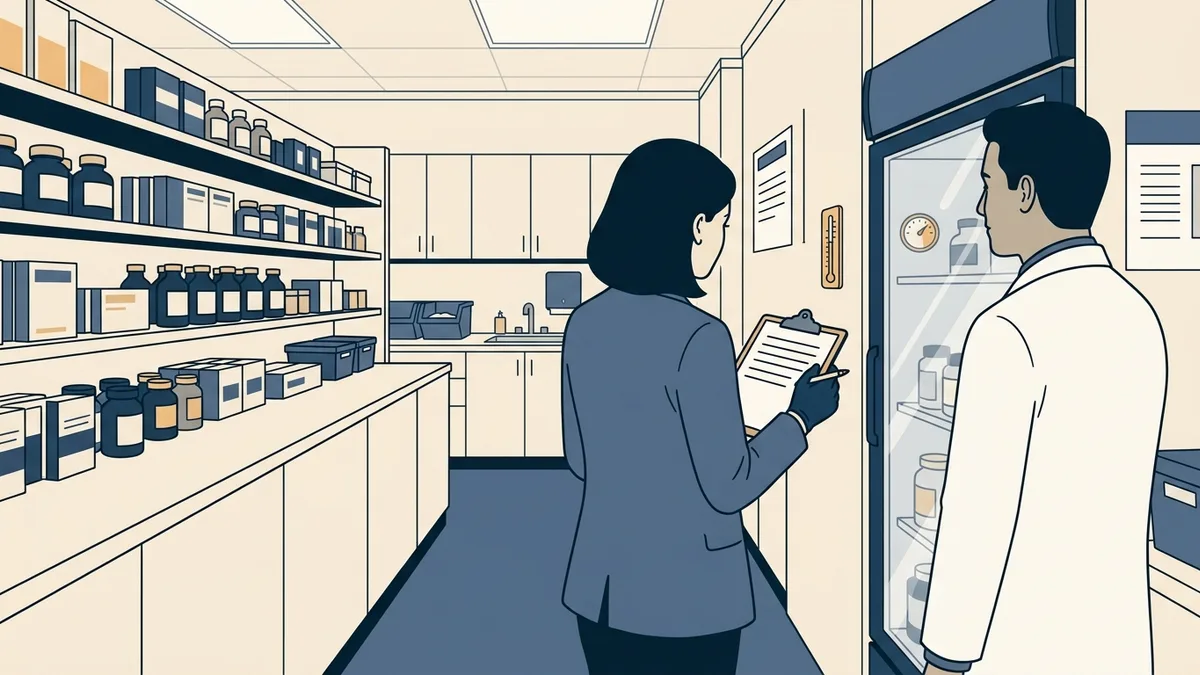
Many states cap the age of the home-state inspection report a nonresident pharmacy submits. Virginia accepts six months for a first registration and two years at renewal, North Carolina 12 months, Kansas 18 months, Texas two years initially and three at renewal, and Oklahoma and Minnesota 24 months. Iowa rejects pre-opening inspections.
The home-state inspection report is the document that most often decides when a nonresident application can go in. Almost every state asks for one, and many set a maximum age, measured from the inspection date to the date the board receives your application. A report that satisfies Texas can be too old for Virginia, and a report that satisfies both can be useless in Washington if it came from the wrong inspector.
Below are the limits written into each state's statute, rule or application, followed by a way to time inspections across many states. The state requirements table carries the same field for every state.
What are the age limits, state by state?
| State | First application | Renewal | Source |
|---|---|---|---|
| Virginia | No more than 6 months old | No more than 2 years old | Va. Code § 54.1-3434.1(A)(3) |
| North Carolina | Within 12 months, home board or NABP VPP | Not stated on the permit page | NC Board of Pharmacy permit page |
| Kansas | Within the previous 18 months | Same 18-month standard to remain registered | K.A.R. 68-7-12a(a)(3) |
| Texas | Not more than 2 years | Not more than 3 years | 22 Tex. Admin. Code § 291.104(a)(2)(F), (a)(3) |
| Iowa | Less than 2 years, done while operating | Same requirements as initial | Iowa Code § 155A.13A(1)(c), (3) |
| Washington | Within 2 years, approved program only | Within 2 years, approved program only | RCW 18.64.360(1)(b); Directive D001 |
| Oklahoma | Within 24 months | Within 24 months | OAC 535:15-3-9(b)(4) |
| Minnesota | Within 24 months, or pay for a Minnesota inspection | Same | Minn. Stat. § 151.19(f) |
| New Jersey | Within the past 2 years, dated copy | Same information at each annual renewal | N.J.A.C. 13:39-4.20(c)(4), (e) |
| Vermont | Retail: within 3 years. Compounding or home infusion: within 2 years | Not stated in the instructions | Vermont application instructions, February 2026 |
| Nebraska | Copies of the last two home-state inspections | Not stated on the form | Mail service pharmacy application |
| Delaware | The most recent qualifying report | Not stated; later reports due within 60 days of receipt | 24 Del. C. §§ 2535(c)(4), 2537(a)(5) |
Several other states ask for "the most recent" home-state inspection report without a stated age, including California (Bus. & Prof. Code § 4112(d)), Florida's basic registration, New Mexico (16.19.6.24(C)(1)(c) NMAC) and Maryland (Md. Code, Health Occ. § 12-403(f)(1)(iii)).
Which states have shorter windows for compounders?
- Maryland: for compounded sterile preparations, a USP 797 inspection conducted within 90 days before the application by a Board designee or approved entity (§ 12-403(f)(1)(v)).
- Florida: for the nonresident sterile compounding permit, an inspection within six months for the initial permit or one year at renewal (Fla. Stat. § 465.0158(3)(e)).
- New Mexico: for compounded sterile preparations, an inspection within the 12 months before the Board receives the application (16.19.6.24(C)(1)(d) NMAC).
- Tennessee: an out-of-state pharmacy engaged in compounding must provide an inspection performed within the previous 12 months (Tenn. Comp. R. & Regs. 1140-01-.08(3)(a)4(i)).
- Georgia: if the pharmacy compounds for practitioners' office use, an inspection no older than two years showing USP-NF compliance (Ga. Comp. R. & Regs. 480-6-.02(2)(b)12).
- Vermont: two years for compounding and home infusion pharmacies, against three for retail.
The sterile side is covered in more depth in nonresident sterile compounding permits by state.
Why does Iowa reject some recent inspections?
Because age is not the only test. Iowa requires that the inspection "occurred while the pharmacy was in operation," states that "an inspection prior to the initial opening of the pharmacy shall not satisfy this requirement," and requires the report to address "all aspects of the pharmacy's business that will be utilized in Iowa" (Iowa Code § 155A.13A(1)(c)). Delaware uses nearly the same language (24 Del. C. § 2535(c)(4)). A brand-new pharmacy with only a pre-opening inspection cannot use it in either state, and a pharmacy that added sterile compounding after its last inspection may need a new one before it applies.
Iowa and North Carolina also look at what the report found. Iowa requires "evidence of corrective actions for all deficiencies noted in the inspection report," and North Carolina asks for documentation of corrective action when the report shows non-compliance. Minnesota may deny licensure until deficiencies are shown to be corrected (Minn. Stat. § 151.19(f)).
What if your home state does not inspect?
Most states that set an age limit also name a fallback:
- Delaware and Iowa accept a report from NABP's Verified Pharmacy Program, or from another qualified entity (Iowa requires it to be preapproved).
- North Carolina names the NABP VPP inspection alongside the home board.
- Texas accepts an inspection by a Board-approved consultant not employed by the pharmacy, an agent of NABP, an agent of another state board or an agent of an accrediting body, if it is "substantively equivalent" to a Texas inspection (22 Tex. Admin. Code § 291.104(a)(2)(F)(i) and (ii)).
- Kansas accepts an inspection by a third party the Board recognizes, at the pharmacy's expense.
- Tennessee accepts an FDA inspection or one performed by NABP.
- Vermont accepts the home board, NABP, FDA or "another qualified third party recognized by the Office, such as Gates Healthcare."
See the NABP VPP inspection when your home state does not inspect.
Is Washington different?
Washington accepts only inspections from programs its Pharmacy Quality Assurance Commission has approved, issued within two years, at both licensure and renewal (RCW 18.64.360(1)(b)). Directive D001 lists those programs. It approves some state boards only for pharmacies that attest they do not compound, does not approve Alaska's inspections, and notes that Hawaii's Board does not conduct inspections. See Washington's approved inspection programs.
How do you time one inspection to work in many states?
- Find your binding constraint. If Virginia is on your list, its six-month limit for a first registration usually controls. If you compound sterile products for Maryland, its 90-day limit does.
- File the tightest states first after the inspection, and the two-year states later in the same cycle.
- Keep a single inspection calendar showing each report's date and the date it ages out for each state, both for new applications and for renewals (Texas allows three years at renewal; Virginia two).
- Send new reports where required. Delaware can discipline a pharmacy that fails to provide inspection reports within 60 days after receiving them from its home state (24 Del. C. § 2537(a)(5)), and Tennessee requires copies of subsequent home-state inspections.
- Close deficiencies in writing before you file, so the corrective action evidence goes in with the report.
Where does White Glove Pharmacy Licensing help?
Our $149 Pharmacy Licensing Readiness Review checks your current report against every state you plan to file in and flags where you need a newer or different inspection. License Renewal Tracking, at $299 per license, per year, includes inspection-report age at renewal. The pharmacy arranges and pays for any inspection directly. The nonresident licensing hub explains how inspections fit into the rest of the application.
Common questions
- Which state has the strictest inspection report age limit?
- For a standard registration, Virginia: no more than six months old for a first application. For sterile compounding, Maryland asks for a USP 797 inspection within 90 days before the application.
- Can I use my pre-opening inspection for a nonresident application?
- Not in Iowa or Delaware. Both require the inspection to have occurred while the pharmacy was operating, and Iowa says a pre-opening inspection does not satisfy the requirement.
- What if my home state does not inspect pharmacies?
- Most states name a fallback. Delaware, Iowa and North Carolina accept NABP's Verified Pharmacy Program, Texas accepts an NABP agent or approved third party, and Vermont accepts NABP, FDA or a recognized third party such as Gates Healthcare.
- Do I have to send new inspection reports after I am licensed?
- In some states, yes. Delaware can discipline a nonresident pharmacy that fails to provide inspection reports within 60 days after receiving them, and Tennessee requires copies of subsequent home-state inspections.
Need Help with Pharmacy Licensing?
We prepare every state's nonresident application for your officers and PIC to sign, coordinate your pharmacists' licenses, and track every one to a decision.