
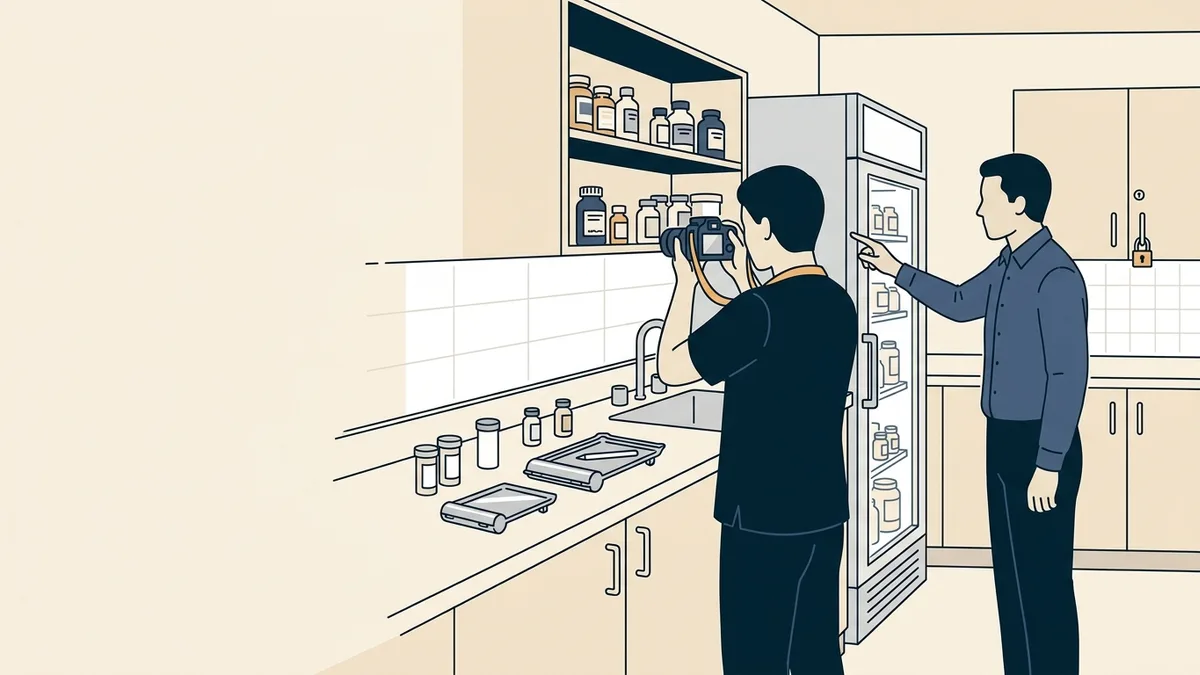
Most nonresident pharmacy applications need a home-state license verification, a recent inspection report, PIC and pharmacist details, ownership and officer records, a label sample, delivery policies, a resident agent, controlled substance registrations if you ship them, and disciplinary disclosures. States such as North Carolina add photos and proof of occupancy, and Texas adds proof of creditworthiness.
Each state writes its own nonresident application, but they ask for the same kinds of evidence. A pharmacy that builds one clean, current set of documents can adapt it to state after state; a pharmacy that gathers documents form by form ends up with five versions of its ownership chart and three different inspection reports in circulation. Below is the working checklist, with what the states that ask for each item actually say.
How do you prove your home-state license?
- Florida: "a letter of licensure verification for the facility and the prescription department manager or your state's equivalent," from the home board, showing the original licensure date, expiration date and status.
- New York: "a copy of your home state license and a completed license verification form (OOS506) from your resident state."
- Nebraska: the home board must send certification of the pharmacy permit and the PIC's license "DIRECTLY TO OUR OFFICE."
- New Jersey: "a letter of good standing from the state licensing authority" (N.J.A.C. 13:39-4.20(c)(5)).
- District of Columbia: a copy of the home-state pharmacy license and, if the state requires one, the certificate of occupancy.
- Vermont: online verifications are acceptable and are uploaded into the application.
Order board-to-board verifications first. They depend on another agency's turnaround.
Which inspection report goes in?
Usually the most recent home-state inspection, within each state's age limit. New Jersey wants "a dated copy of the most recent inspection report resulting from an inspection within the past two years" (N.J.A.C. 13:39-4.20(c)(4)), Nebraska the last two reports, and North Carolina one within 12 months, with corrective-action documentation if it found problems. See inspection report age limits by state.
What do states ask about the PIC and pharmacists?
- PIC identity and license: DC wants the PIC's name and a copy of their license in the home state. New Jersey wants the PIC's home-state license number "and his or her weekly hours of employment" (N.J.A.C. 13:39-4.20(c)(3)).
- PIC statements: Texas requires a PIC affidavit about Class E rules (22 Tex. Admin. Code § 291.104(a)(2)(D)); DC a PIC signature on the application affidavit; Vermont a statement of pharmacist-in-charge form.
- In-state licensed PIC: in states that require one, the PIC's license from that state, such as Oklahoma's "name and license number of an Oklahoma licensed pharmacist in charge" (OAC 535:15-3-9(b)(6)).
- All pharmacists: DC asks for a list of pharmacists practicing at the location and their license numbers; Nebraska asks for all pharmacists who work at the pharmacy.
Which ownership and officer records are needed?
- Florida asks for every "principal, officer, agent, managing employee or affiliated person," defined as anyone with 5 percent or more ownership or who manages or controls the pharmacy, plus the articles of incorporation and a certificate of status from the Secretary of State.
- Vermont wants evidence the business name is registered with the Vermont Secretary of State and "a flow chart showing ownership."
- North Carolina asks for a corporate organization chart covering "all entities holding and ownership or beneficial interest in the pharmacy, as well as the pharmacy's staff," and a separate ownership document, Certificate A, uploaded after submission.
- New Jersey wants the names and titles of all principal corporate officers (N.J.A.C. 13:39-4.20(c)(2)).
Build the ownership chart once, all the way to the top, with percentages, and reuse it.
Do you need a label sample?
Often. New Jersey asks for "a copy of the prescription label to be used by the pharmacy," DC for a "computer-generated prescription label," and North Carolina for a "completed label." The label should show the toll-free number the state requires. See the toll-free pharmacist line and label rules.
Where do written policies come in?
Alabama and New Mexico each require a policy and procedure manual covering normal delivery times, delayed shipments, prescriptions for acute illness and patients who run out before delivery (Ala. Admin. Code r. 680-X-2-.07(6); 16.19.6.24(D)(2) NMAC). Florida's sterile compounding permit requires sterile compounding policies that comply with USP chapter 797 (Fla. Stat. § 465.0158(3)(d)).
Where does the resident agent go?
New York uses a separate form (OOS507). DC, Georgia, Maryland and New Mexico ask for the agent on the application, and Kansas requires a filing with the Secretary of State. See resident agents for out-of-state pharmacies.
What about controlled substances?
- District of Columbia: a separate controlled substance registration application if you will ship controlled substances, plus copies of your home-state controlled substance registration and DEA registration "if applicable."
- New Mexico: a Board controlled substance application before shipping controlled substances (16.19.6.24(C)(1)(h) NMAC).
- Vermont: DEA registration information if controlled substances will be shipped, plus registration with the Vermont Prescription Monitoring System.
- Florida: the application asks for the DEA registration number.
Is other operational evidence needed?
- North Carolina: the NABP business e-Profile number, EIN, photographs of the building exterior and the pharmacy interior (prescription area, dispensing and storage areas, all equipment), and proof of occupancy such as a lease signature page, deed or certificate of occupancy.
- Texas: proof of creditworthiness and evidence the pharmacy can produce a Texas resident's prescription record within 72 hours (22 Tex. Admin. Code § 291.104(a)(2)(C) and (E)).
- Iowa: evidence the pharmacy keeps records of controlled substances delivered to Iowa patients (Iowa Code § 155A.13A(1)(d)).
- Vermont: an FDA establishment identifier if applicable, and information about FDA inspections and actions within the past five years.
- DC: NABP's VIPPS or another national certification "if applicable."
How do you handle disciplinary history and background?
Florida's application asks about specific felony convictions, Medicaid terminations and listing on the HHS Office of Inspector General's exclusion list for the applicant and every affiliated person, and asks whether the applicant holds permits in other states. Nebraska wants a letter of explanation and documentation for any action against the pharmacy, the PIC or its Nebraska-licensed pharmacist. Michigan requires disclosure of every pharmacy license held elsewhere, with verification from each issuing entity that no discipline is pending, and fingerprints for a criminal history check (Mich. Admin. Code R 338.531(2)(b) and (k)). Answer every question; Florida's application warns that unanswered questions mean the application "WILL BE RETURNED."
Does Michigan's list look different?
Michigan uses one pharmacy license application for in-state and out-of-state pharmacies, and its rule spells out the attachments. An applicant submits certified copies of its articles of incorporation or partnership certificates and any assumed name certificates, fingerprints for a criminal history check, a FEIN certificate, the name and license number of the Michigan-licensed pharmacist designated as PIC, the identity and address of each partner, officer or owner, and a completed self-inspection form. An out-of-state pharmacy that will not provide sterile compounding services adds an inspection report meeting R 338.534 (Mich. Admin. Code R 338.531(2)). The certified copies and fingerprints are the items that take longest, so order them at the start.
Can one document set stay current?
Date every document, note which states received which version, and replace items as they age: inspection reports, verifications, officer lists and PIC details all go stale. Applications also expire. Florida says an incomplete application "will expire after one year," New Mexico treats one not completed within 12 months as withdrawn (16.19.6.24(C)(1)(j) NMAC), and Nebraska destroys an application whose supporting documents are not in within 150 days.
How does White Glove Pharmacy Licensing help?
We build the master document set, tailor it to each state's form, flag every signature and notary line for your owners, officers and PIC, and track each board's requests. A Readiness Review ($149, credited toward a package) shows what you already have. Applications are $599 per standard state and $899 per complex state; board, verification, fingerprint and notary fees are paid by the pharmacy. See also who signs a nonresident pharmacy application.
Common questions
- What is the first document to order for a nonresident pharmacy application?
- The home-state license verification. Florida wants a verification letter from your home board, New York its OOS506 form completed by the resident state, and Nebraska certification sent directly from your board, so it depends on another agency's timing.
- Do states require a sample prescription label?
- Many do. New Jersey asks for a copy of the label the pharmacy will use, DC for a computer-generated label and North Carolina for a completed label. It should show the toll-free number the state requires.
- How long does an incomplete application stay open?
- It varies. Florida's incomplete applications expire after one year, New Mexico treats an application not completed within 12 months as withdrawn, and Nebraska destroys one whose supporting documents are not received within 150 days.
Need Help with Pharmacy Licensing?
We prepare every state's nonresident application for your officers and PIC to sign, coordinate your pharmacists' licenses, and track every one to a decision.