
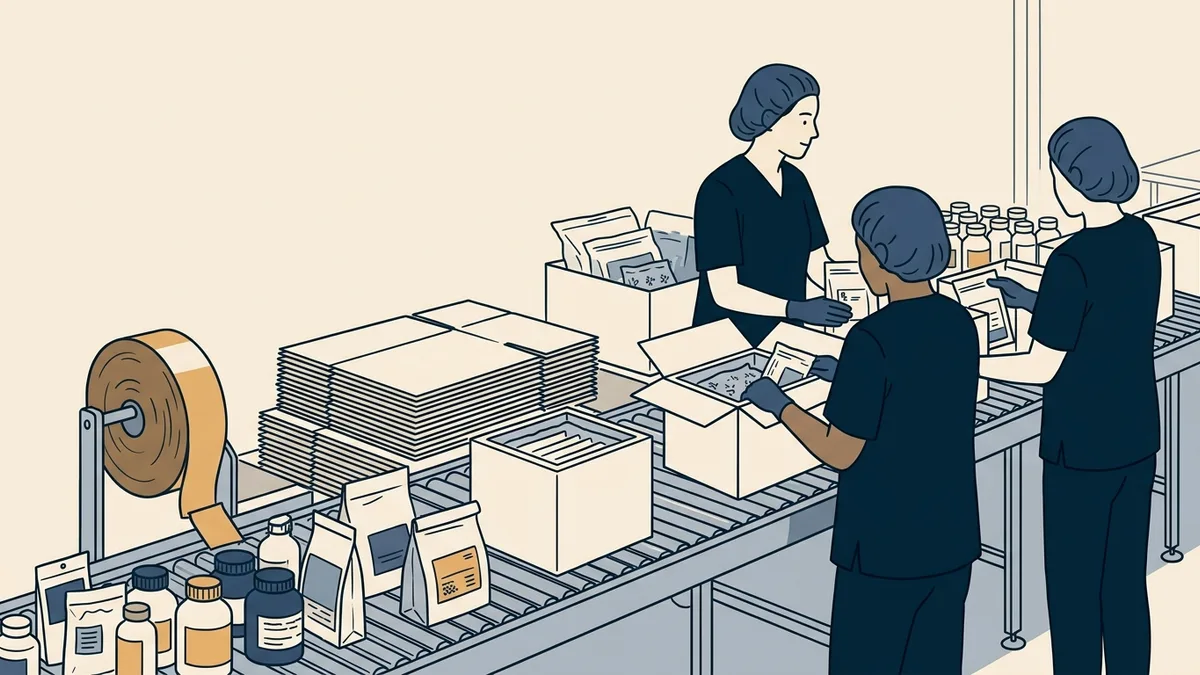
A mail-order pharmacy needs a nonresident license in each state it ships to. Some states add mail-order rules: Alabama issues a Mail Order Permit with an Alabama-licensed supervising pharmacist, Nebraska wants a full-time Nebraska-licensed pharmacist, Maryland and Delaware require temperature notices in each package, and Texas wants records produced within 72 hours.
A mail-order pharmacy is licensed where it sits and, separately, in every state it ships to. Each destination state has its own nonresident license, registration or permit, and some have rules written with mail-order work in mind: how medications travel, what goes in the box, how fast records come back when the board asks, and which pharmacist answers for that state's patients. The licensing plan for a national mail-order pharmacy is really dozens of small plans run in parallel.
Here is what the states we see most often ask of a pharmacy that ships, using their own language. For the general framework, start with nonresident pharmacy licenses: what every shipping pharmacy needs.
Which states write rules specifically for mail order?
Alabama
Alabama issues a Mail Order Permit, renewed biennially, and "no nonresident pharmacy shall ship, mail or deliver prescription drugs and/or devices to a patient in this state unless registered" (Ala. Admin. Code r. 680-X-2-.07(1) and (2)). The permit holder must designate a supervising pharmacist "licensed by the Alabama State Board of Pharmacy," name a resident agent for service of process, and give the Board a policy and procedure manual covering normal delivery times, delayed shipments, acute-illness prescriptions and patients who run out before a package arrives (r. 680-X-2-.07(3), (4)(f) and (6)). If the supervising pharmacist leaves, the pharmacy has 10 days to file a plan and no more than 90 days before it is operating without one. See Alabama's mail order permit and supervising pharmacist.
Nebraska
Nebraska's application is titled "Application for Mail Service Pharmacy Permit." It asks the pharmacy to confirm that it "currently employs a Nebraska licensed pharmacist on a full-time basis when Nebraska prescriptions are being processed," and notes that this pharmacist does not need to be the PIC. That pharmacist signs a statement accepting responsibility for compliance. The application fee is $625, and the pharmacy sends copies of its last two home-state inspection reports. See Nebraska's mail service license and full-time pharmacist.
South Carolina
South Carolina's permit statute reaches out-of-state facilities "whose primary business is mail order pharmacy service," requires a permit for each location, and requires renewal by June 1 every year (S.C. Code § 40-43-83(A)). Every out-of-state pharmacy shipping into South Carolina must designate a registered agent there (§ 40-43-83(B)).
What do states require about the shipment itself?
Several states regulate the package, not just the pharmacy:
- Texas requires a Class E pharmacy to use shipping processes, packaging material and devices that keep each drug "at an appropriate temperature range" throughout delivery, and a delivery system "designed to assure that the drugs are delivered to the appropriate patient" (22 Tex. Admin. Code § 291.104(b)(1)(B) and (C)).
- Maryland requires a written notice in each shipment that a medication's effectiveness may be affected by heat, cold or humidity, plus a toll-free or local number for questions (Md. Code, Health Occ. § 12-403(c)(17)).
- Delaware requires the same kind of temperature notice in the shipping container, along with notice of a pharmacist-staffed telephone service (24 Del. C. § 2535(b)).
- Texas also requires a toll-free line when prescriptions routinely go outside the local calling area, and a statement in English and Spanish giving the pharmacy's local and toll-free numbers on the container or a separate sheet (§ 291.104(b)(3)(D) and (E)).
Nearly every state also requires the toll-free number on each label. The specifics are in the toll-free pharmacist line and label rules.
How fast must records come back to a board?
Mail-order pharmacies are asked to keep each state's records separable and quick to produce. Texas requires evidence that the pharmacy can provide a record of a prescription dispensed to a Texas resident "not later than 72 hours" after the Board asks (22 Tex. Admin. Code § 291.104(a)(2)(C)). Virginia requires dispensing records to be provided within seven days of a request (Va. Code § 54.1-3434.1(A)(5)). Oklahoma requires prescription records for Oklahoma residents to be kept for at least five years (OAC 535:15-3-9(e)(1)). Florida, Alabama, Washington and others require records for their residents to be "readily retrievable" from the rest of the pharmacy's records. A dispensing system that can filter by ship-to state saves a scramble later.
Which pharmacist answers for each state?
Most states accept pharmacists licensed where the pharmacy is located, but mail-order pharmacies run into in-state pharmacist rules more than anyone, because they ship everywhere. California's rule became operative July 1, 2026: the PIC must be a California-licensed pharmacist "employed and working at the nonresident pharmacy" (Bus. & Prof. Code § 4112(d)). Illinois has required an Illinois-licensed PIC since January 1, 2026 (68 Ill. Adm. Code 1330.550(a)). Texas, Virginia, Oklahoma, Oregon, Kentucky, Tennessee, Alabama, Arkansas and Michigan have their own versions.
For a pharmacy with one PIC and a national footprint, that can mean one pharmacist holding a dozen or more licenses. Some states let the in-state pharmacist be someone other than your home-state PIC: Arkansas says its PIC "need not be the same person" as the PIC under home-state law (Rule 04-04-0001(2)), and Nebraska's full-time pharmacist need not be the PIC. Others do not. Planning which pharmacists to license in which states covers how to spread the load.
Can a mail-order pharmacy run from a home or shared space?
Usually not. Oklahoma requires a nonresident pharmacy to "be in a commercial location and not a personal dwelling or residence" (OAC 535:15-3-9(b)(5)), and NABP's Verified Pharmacy Program will not inspect a pharmacy located in a personal residence. North Carolina's permit application asks for proof of occupancy, such as a lease signature page, deed or certificate of occupancy, plus photographs of the building, the prescription area and all equipment. A start-up mail-order pharmacy that plans to begin in a small shared suite should confirm its home state and its first target states will accept the space before signing a lease.
In what order should a mail-order pharmacy file?
- Fix the inspection first. Virginia wants an inspection no more than six months old for a new registration (Va. Code § 54.1-3434.1(A)(3)), North Carolina 12 months, Kansas 18 months. If your last home-state inspection is old, the timing of the next one drives everything. See inspection report age limits by state.
- Start pharmacist licensing early in the in-state PIC states, because the facility application cannot finish without a licensed PIC.
- File standard states in batches, grouped by the documents they share: same verification letter, same inspection report, same label sample.
- Add controlled substance registrations where you ship controlled substances. New Mexico, for example, requires DEA registration and a Board controlled substance registration before shipping them (16.19.6.24(B)(1) NMAC).
- Set up tracking on day one. You will have renewals every month of the year. See tracking dozens of pharmacy licenses.
Who signs, and who submits?
Your owners, officers and PIC sign every attestation and notarized page; Florida, for instance, requires "the original signature of the owner or officer," and New York's signature page must be notarized. We prepare each application and its attachments, and send signed paper or emailed applications for you where the board accepts them. Online portals stay in your own account. In North Carolina, the pharmacist-manager must complete, attest and submit the permit application; we prepare the documents and a question-by-question guide for them. See who signs a nonresident pharmacy application.
Where do payer networks and telehealth partners fit?
Licensing lets you ship. Getting paid is separate: network contracts with Part D plans, PBMs and Medicaid programs are a contracting job, which our sister company White Glove Credentialing handles. If telehealth platforms send you prescriptions, they will ask for your license list state by state. Our sister company White Glove Telemedicine explains what practices look for in a pharmacy partner.
How is the work priced?
Our pricing is per state: $599 for a standard state, $899 for each of the 13 complex states with in-state PIC rules, or $4,995 for 10 states, $10,995 for 25 and $17,995 for every jurisdiction that licenses nonresident pharmacies. PIC Licensing Coordination for your own pharmacists is $399 per state per pharmacist, and License Renewal Tracking is $299 per license, per year. Board fees, such as Nebraska's $625, are paid by the pharmacy directly. Check each state on the requirements table.
Common questions
- Do mail-order pharmacies need a license in every state they ship to?
- In nearly every state, yes. Each state's nonresident license, registration or permit must be in place before shipping there. A few states can exempt isolated transactions on application, and Massachusetts licenses only certain shipments.
- What does Nebraska require of a mail-order pharmacy?
- Nebraska's mail service pharmacy application asks for a full-time Nebraska-licensed pharmacist employed while Nebraska prescriptions are processed (not necessarily the PIC), the last two home-state inspection reports and a $625 fee.
- What must go inside a mail-order shipment?
- Maryland and Delaware require a notice that heat, cold or humidity can affect a medication, plus a pharmacist phone number. Texas requires packaging that keeps drugs in an appropriate temperature range and a statement in English and Spanish with the pharmacy's local and toll-free numbers.
- How quickly must a mail-order pharmacy produce records?
- Texas asks for evidence the pharmacy can provide a Texas resident's prescription record within 72 hours of a Board request. Virginia requires dispensing records within seven days of a request.
Need Help with Pharmacy Licensing?
We prepare every state's nonresident application for your officers and PIC to sign, coordinate your pharmacists' licenses, and track every one to a decision.