
A central-fill pharmacy can need nonresident licenses in states where it never ships to a patient. Minnesota licenses any out-of-state site where any portion of dispensing occurs for Minnesota residents, New Jersey requires registration and Board approval for central prescription handling, and New Mexico counts entry and verification as delivering.
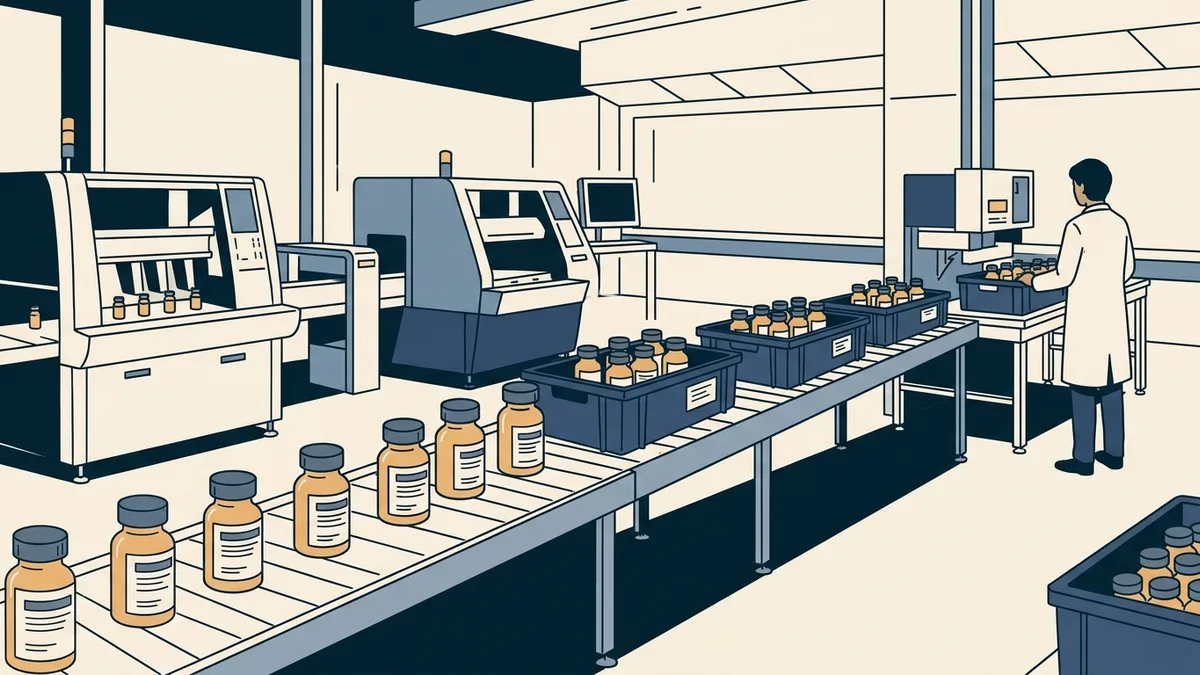
Central-fill pharmacies fill prescriptions on behalf of other pharmacies. Some send the finished prescriptions back to the originating pharmacy for pickup; others ship straight to the patient. Either way, when the originating pharmacy or the patient is in another state, the central-fill site is doing pharmacy work for that state, and many states license it for that.
The question to ask is not "do we ship to patients there?" but "does any part of the dispensing process for that state's patients happen here?"
How do states define central fill?
The federal definition is a useful starting point. The DEA defines a central fill pharmacy as one "permitted by the state in which it is located to prepare controlled substances orders for dispensing pursuant to a valid prescription transmitted to it by a registered retail pharmacy and to return the labeled and filled prescriptions to the retail pharmacy for delivery to the ultimate user," and treats it as authorized only where the two pharmacies have a contract or share a common owner (21 C.F.R. § 1300.01).
States write their own versions. Texas defines a central fill pharmacy as a pharmacy, including a Class E (non-resident) or Class E-S pharmacy, that prepares prescription drug orders for dispensing on a prescription transmitted by an outsourcing pharmacy. Its centralized dispensing can involve returning prescriptions to the outsourcing pharmacy "or at the request of the outsourcing pharmacy for direct delivery to the patient" (22 Tex. Admin. Code § 291.125(b)). New Jersey splits prescription handling into four functions (intake, processing, fulfillment and dispensing) and names a central fill pharmacy as one that fills or refills prescriptions, "which includes the preparation and packaging of the medication" (N.J.A.C. 13:39-4.19(a) and (c)).
Which states license a central-fill site that never ships to patients?
Several statutes reach past the shipping step:
- Minnesota requires "a separate license ... for each pharmacy located outside of the state at which any portion of the dispensing process occurs for drugs dispensed to residents of this state" (Minn. Stat. § 151.19(e)).
- New Jersey requires an out-of-state pharmacy that "participates in a central prescription handling arrangement" to register (N.J.A.C. 13:39-4.20(a)). Before any central prescription handling starts, all the participating pharmacies must get Board approval through a single application describing each pharmacy's role (N.J.A.C. 13:39-4.19(d)(2)).
- New Mexico counts "the provision of dispensing process pharmacy services such as prescription entry, prospective drug review, or prescription verification" as delivering for its nonresident definition (16.19.6.24(A)(2) NMAC).
- California treats any out-of-state pharmacy "involved in the preparation, dispensing, shipping, mailing, or delivery" of drugs into California as a nonresident pharmacy (Bus. & Prof. Code § 4112(a)).
- New York registers out-of-state pharmacies that take part in "shared pharmacy services" for New York pharmacies or patients (N.Y. Educ. Law § 6808-b(1) and (2)).
The same logic applies to central processing sites that do data entry, drug review or verification for another state's pharmacies. New Jersey's rule names a "central processing pharmacy" as a participant in its own right (N.J.A.C. 13:39-4.19(c)(2)).
What do Texas rules require of an out-of-state central-fill pharmacy?
Texas lets a Class E pharmacy outsource dispensing to a central fill pharmacy, and expects a central fill pharmacy serving Texas to hold the right license class. The two pharmacies must have the same owner or a written contract setting out each one's responsibilities, and must share a common electronic file or technology giving access to the information needed to dispense (22 Tex. Admin. Code § 291.125(c)(1)). The central fill PIC must make sure shipments use appropriate temperature-controlled packaging and tamper-evident sealed containers, and a Class E central fill pharmacy must follow the Class E rules in §§ 291.101 to 291.105. Before outsourcing, the outsourcing pharmacy has to tell patients their prescription may be filled at a central fill pharmacy and name it, or explain that any pharmacy in its commonly owned network may fill it (§ 291.125(c)(2)).
How does the DEA treat central fill?
A central fill pharmacy that handles controlled substances needs its own DEA registration. Central fill is a listed dispensing category, at $888 for a three-year registration (21 C.F.R. § 1301.13(e)(1)(iv)), and the DEA requires a separate registration for each principal place of business (§ 1301.12(a)). For Schedule III to V prescriptions, both pharmacies keep specific records: the retail pharmacy writes "CENTRAL FILL" on the original and records the central fill pharmacy's name, address and DEA number, and the central fill pharmacy keeps the transmitted information (21 C.F.R. § 1306.27). State controlled substance registrations may also apply. See DEA registration for each pharmacy location.
Does each central-fill site need its own licenses?
Yes. Nonresident licenses attach to locations. Minnesota's rule speaks of each pharmacy where any portion of dispensing happens, Michigan issues "only 1 pharmacy license per address" (Mich. Admin. Code R 338.531(3)), and Texas issues a separate license for each principal place of business (22 Tex. Admin. Code § 291.104(a)(8)). A network with two central-fill sites serving 20 states may need up to 40 nonresident licenses, plus the originating pharmacies' own. See one license per dispensing location.
Where should a central-fill operator start mapping?
- List every state where an originating pharmacy you serve is located, and every state you ship to directly.
- Note which steps your site performs for each: entry, verification, filling, packaging, shipping.
- Check each state's definition against those steps, using the citations above and the state requirements table.
- Add the in-state PIC states, which need your pharmacist licensed there regardless of who ships.
- Plan DEA and state controlled substance registrations for each site.
Our $149 Readiness Review does this mapping and is credited toward any package. Per-state applications are $599 for a standard state and $899 for a complex state, and change filings when you add a site or move one are $149 per state. Owners, officers and the PIC sign; the pharmacy pays board and DEA fees directly. The nonresident licensing hub has the full process.
Common questions
- Does a central-fill pharmacy need a license in the originating pharmacy's state?
- Often, yes. Minnesota requires a license for any out-of-state pharmacy where any portion of the dispensing process occurs for Minnesota residents, and New Jersey requires an out-of-state pharmacy in a central prescription handling arrangement to register and get Board approval.
- Does a central-fill pharmacy need its own DEA registration?
- Yes, if it handles controlled substances. Central fill is a DEA registration category costing $888 for three years, and the DEA requires a separate registration for each principal place of business.
- Do central processing sites that only verify prescriptions need licenses?
- In some states. New Mexico treats prescription entry, prospective drug review and verification as delivering, and New Jersey names central processing pharmacies as participants in central prescription handling.
Need Help with Pharmacy Licensing?
We prepare every state's nonresident application for your officers and PIC to sign, coordinate your pharmacists' licenses, and track every one to a decision.